

How Much Does a Home Cinema Cost? Planning Your Budget
What goes into a home cinema budget: design, sound isolation, audio, video and building services. Where to invest, where to save and how to plan for future upgrades.
Cinema Project · Design and Engineering
One of the first questions that future owners of home cinemas ask us is how much will it cost to implement the project?
At first glance, it seems that it is enough to know the area of the room, the number of seats and the desired screen size. However, architecture, sound insulation, acoustic design, equipment, building services, interior and requirements for the quality of reproduction – all this affects the final cost.
We will figure out how to properly plan the budget of the home cinema, what expenses should be foreseen in advance and where the savings are really justified.
Why doesn’t a home cinema have a universal cost per square metre?
Imagine two rooms with the same area of 40 m². The first one has a laser projector, Dolby Atmos multichannel audio system, several subwoofers and comfortable recliner chairs. In the second - professional RGB-laser projection, higher-output loudspeakers, a complex low-frequency control system, electronic screen masking, individual furniture and an independent soundproofing shell.
The area is the same, and the cost of implementation can vary several times.
The budget is affected by the geometry and volume of the room, the requirements for sound insulation, the number of seats, screen size, image technology, sound quality, finishing materials, the complexity of building services and automation.
Therefore, to determine the cost, it is necessary to understand the technical specification, and not only the area of the room.
How does the CEDIA RP22 level affect the cost of a cinema?
When designing private cinemas, Cinema Project is guided by international industry recommendations CEDIA/CTA-RP22. The document provides four levels of sound reproduction quality - from Level 1 to Level 4.
Each successive level imposes more stringent requirements on the accuracy of the soundfield, dynamic range, bass depth, uniformity of sound and background noise.
CEDIA RP22 does not set the cost of a cinema or tie levels to price categories or manufacturers. However, achieving higher performance usually requires additional engineering solutions: higher-output loudspeakers, amplifiers with sufficient headroom, additional subwoofers, complex acoustic design and quiet engineering systems.
Therefore, an increase in the quality target is often accompanied by an increase in the budget. Expensive equipment alone does not guarantee a high level of RP22: the result depends on the design, implementation and validation of performance measurements.
More info in the section "Standards of design". Design Standards CEDIA/CTA RP22
What is the budget of the home cinema?
Below is an indicative structure of investments in the creation of a fully equipped home cinema.
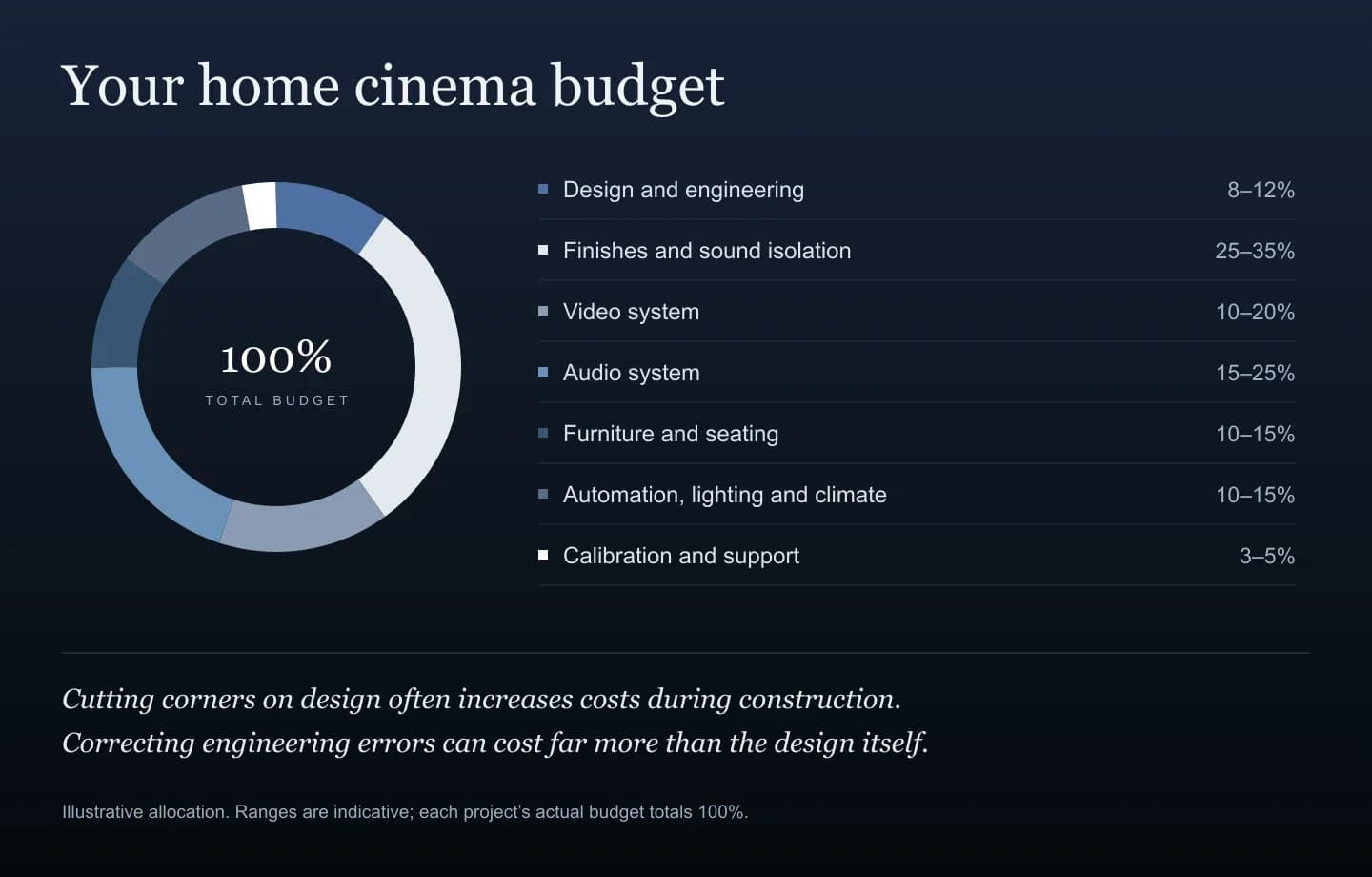
Budget structure: indicative allocation of investments. Shares in a particular project are determined individually.
Direction | Budget share |
|---|---|
Design and engineering | 8–12% |
Finishing and soundproofing | 25–35% |
Video system | 10–20% |
Audio system | 15–25% |
Furniture and chairs | 10–15% |
Automation, light and climate | 10–15% |
Calibration and maintenance | 3–5% |
The ranges are indicative and do not add up directly: the actual distribution is determined individually, and the line items in each actual budget add up to 100%.
01. Design and engineering
At this stage, geometry, location of spectator seats, acoustic configuration, projection parameters, sound insulation and building services are determined. The full Cinema Project project includes a BIM model, acoustic modelling and ten sections of documentation. The final album usually contains 80-120 A3 sheets. Complete cycle of design and implementation
Savings on design can lead to the transfer of communications, redesign of structures and replacement of equipment. The cost of correcting errors can significantly exceed the cost of the project itself. acoustic modelling of the home cinema
02. Construction, sound insulation and finishing
Independent sound-isolating structures, vibration isolation, seating risers, acoustic design and final finishes occupy a significant part of the budget. Replacing the projector after a few years is relatively simple, and remaking the soundproofing shell after finishing is much more difficult.
03. Video system
The cost depends on the screen size, image technology, brightness, contrast and HDR playback. This can be a laser-phosphor or RGB-laser projection, professional film projection or MicroLED. The budget also includes screen, optics, video processor, signal routing, mounts and masking. With a limited budget, you can choose a more affordable projector with the possibility of updating, calculating the screen and projection distance in advance.
04. Audio system
loudspeakers, subwoofers, audio processors, amplifiers, cables and signal routing are selected to meet the requirements for volume, dynamics and uniformity of sound. A competently designed system with affordable components can give a better result than expensive equipment installed without taking into account the room acoustics.
05. Furniture and interior
The cost of chairs and reclining sofas depends on upholstery materials, mechanisms, functions and individual sizes. You can optimize the budget by choosing the specification and decorative solutions, maintaining the correct ergonomics, passages, height of seating risers and lines of sight.
06. Automation, lighting and climate
One of the most underrated items of expenditure. It is necessary to ensure air exchange, comfortable temperature, cooling of equipment racks and low noise level. This also includes architectural lighting, step lighting, light scenarios, control and integration with a smart home. Nine engineering systems of the home cinema
07. Calibration and maintenance
After installation, acoustic measurements, audio processor tuning, image calibration and automation verification are carried out. In our projects, audio calibration takes at least three days and video calibration takes an average of one to two days. Further maintenance, diagnosis and recalibration should also be considered. Sound and image calibration
What can you save on?
- A more affordable projector model with the possibility of subsequent updates.
- Simplification of decorative elements of the interior.
- Standard furniture sizes and a reduction in the additional functions of recliners.
- Fewer additional content sources and automation scenarios.
- Gradual upgrade of equipment with a pre-prepared infrastructure.
Each change should be evaluated in terms of its impact on the overall characteristics of the system.
What can't you save on?
- Engineering Design and acoustic modelling.
- Geometry of the room and location of spectator seats.
- Necessary sound isolation and vibration control.
- Hidden cable infrastructure, electrical security and equipment protection.
- Ventilation and cooling.
- Acoustic design necessary to achieve design characteristics.
- Installation work and instrumental calibration.
When optimizing the budget, we recommend first reviewing decisions that can be changed or upgraded in the future.
What costs are most often overlooked?
With self-planning, customers often focus on the cost of the projector, loudspeakers, amplifiers and screen. Outside this list are equipment rack cooling, acoustic ventilation mufflers, building reinforcements, cable tracks, mounts, technical hatches, power supply, automation programming and software licenses.
For international projects, logistics, customs costs, taxes and business trips of specialists can be additionally taken into account. For a professional cinema screening, DCI must separately assess the equipment and costs of organizing licensed screenings.
It is advisable to provide a financial reserve for unforeseen works, especially during the reconstruction of an existing premises.
Is it possible to create a cinema with the possibility of further upgrades?
Yes. In the engineering project, it is possible to provide cable routes for additional audio channels, power supply reserve, free space in equipment racks and the possibility of installing a higher-performance projector. This allows you to allocate the investment over time and modernize the system without large-scale intervention in the interior. Upgrade and modernisation of the cinema
How to determine the budget of the home cinema?
We recommend starting with a design brief and a concept design. The purpose of the room, the number of seats, use scenarios, the desired level of quality, the architectural concept and the preliminary composition of the equipment are determined.
At Cinema Project, the preparation of the sketch takes 3-5 days. Based on its results, it is possible to form a preliminary budget structure and compare technical concepts. A more accurate cost is determined after the development of working documentation, calculations, specifications and volumes of construction work.
Budget as part of an engineering project
A home cinema is a space that can serve a family for decades, evolving with technology. When planning investments, it is important to take into account the durability of structures, modernisation opportunities, ease of operation and further maintenance.
At Cinema Project, we begin the budget discussion with an understanding of what your future cinema room should be like. Based on these requirements, we form an engineering concept and determine the cost of its implementation.
Frequently asked questions
How much does it cost to build a complete home cinema?
The cost is determined individually and depends on the architecture, sound insulation, equipment, engineering systems and interior. The preliminary budget is formed at the preliminary design stage.
Can you calculate the cost per square metre?
Area is just one of the initial parameters. Two identical spaces can vary significantly in cost due to technical requirements and construction solutions.
Does the CEDIA RP22 Level Affect Cost?
Higher levels usually require additional engineering solutions and higher-performance equipment, but RP22 does not establish a direct relationship between budget and quality.
Which is more important: expensive equipment or acoustic design?
Both directions are interrelated. The optimal budget allocation is determined on the basis of engineering calculations.
Is it possible to upgrade the cinema later?
Yes, if you pre-plan the infrastructure to replace the projector, expand the audio system and update other components.
How to find out the preliminary cost of your cinema?
Provide a layout, describe use cases and wishes. Based on this data, Cinema Project can prepare a design concept and a preliminary budget estimate.
Let's start with your project.
Send the layout of the room and tell how you imagine your future home cinema. We will prepare a design concept, propose technical solutions and determine the preliminary investment structure.