

Video at home cinema
The image for which you want to extinguish the light
The big screen changes the perception of the film. The viewer notices the details, feels the scale of the space and ceases to perceive the image as a separate object on the wall. But size is only one component. What matters is how accurately the system conveys the light, colour, movement and intent of the filmmakers.
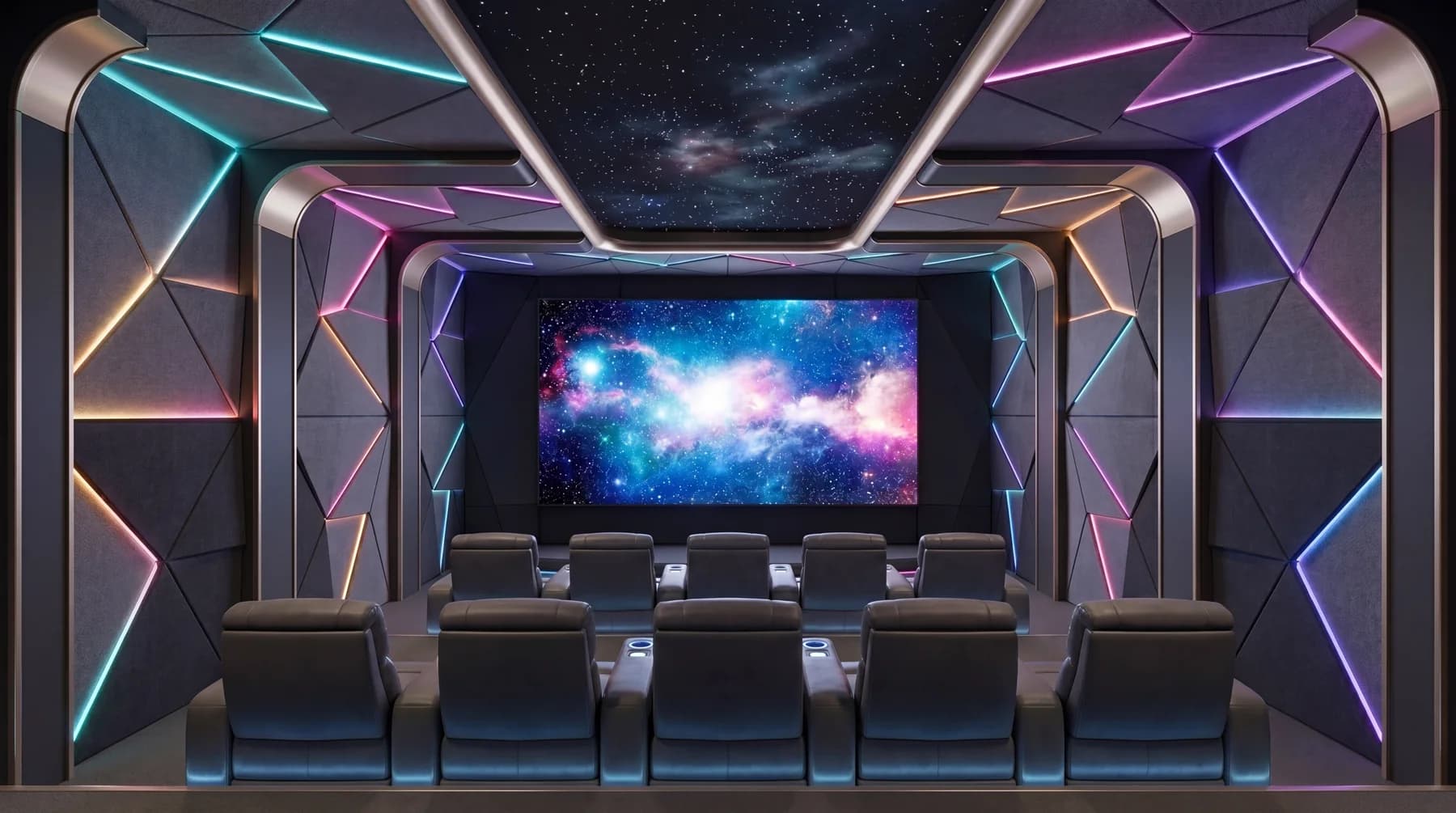
At Cinema Project, we design video systems for dedicated home cinemas, private cinemas with the possibility of professional film screening and multifunctional media rooms. We choose the image technology, calculate the screen and the position of the audience, coordinate the projection with the architecture and lighting, select the processing of the video signal and provide for subsequent configuration.
We rely on applicable CEDIA/CTA-RP22 guidelines, SMPTE documents, manufacturers’ specifications and industry practices. The project begins with the premises and usage scenarios: what movies will be watched, how many viewers will be, whether a game mode is needed, whether it is possible to completely darken the room and what image is expected at each place.
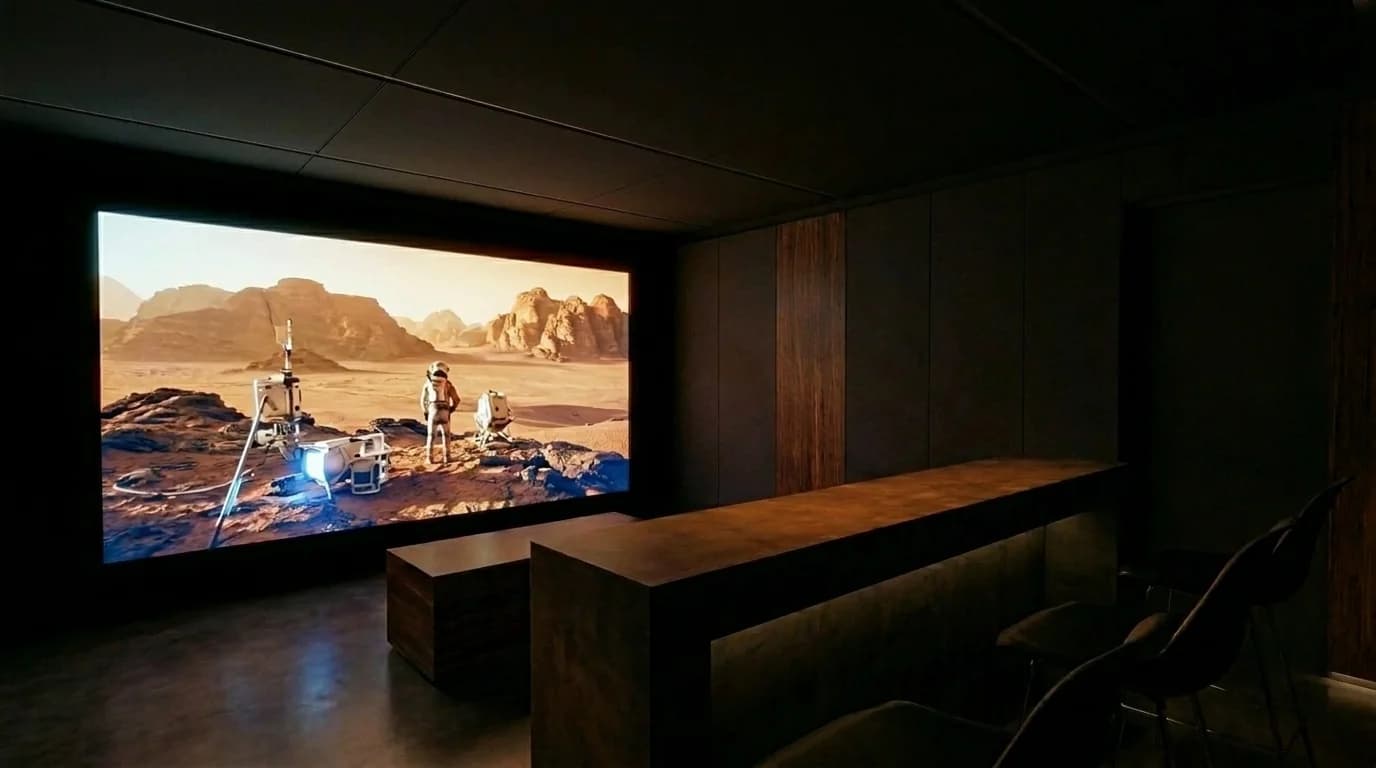
Projector: How the image appears
The projector forms the image with light and directs it to the screen. Inside, there is a light source, an optical system and elements that control the image. It is their combination that affects brightness, contrast, colour and clarity.
Previously, lamp projectors were widely used in home cinemas. They are found today, but in new projects we mainly consider laser solutions : they allow you to obtain a stable light flux, have a long life of the light source and do not require regular replacement of the projection lamp.
Laser-phosphor and RGB laser projectors
Laser-phosphor technology uses laser light and a phosphor coating that converts some of the radiation into light of other colours. This is a common solution with a good balance of brightness, image quality and cost.
RGB laser forms the primary colours - red, green and blue - using separate laser sources. Such a system is able to provide a very wide colour coverage, which is especially interesting for large screens and high requirements for colour reproduction. At the same time, the inscription RGB Laser does not guarantee a better picture: optics, contrast, signal processing and tuning quality are important.
In both cases, the projector can use different imaging technologies. The source of light and the type of matrix are two different characteristics and should not be confused.
DLP and LCoS: Two Image Technologies
DLP (Digital Light Processing) is a technology in which an image is formed using microscopic mirrors controlled by electronics. DLP projectors are valued for high brightness, image accuracy and wide application - from compact devices to professional film screening.
LCoS (Liquid Crystal on Silicon) is a technology of reflective liquid crystal matrices on a silicon substrate. It is used, in particular, in high-end home film projectors and allows you to obtain very fine image structure and deep dark scenes. Manufacturers have their own names for this technology, such as SXRD in Sony and D-ILA in JVC.
You can’t say that one technology is the best. The characteristics of a particular projector, screen, room conditions and tasks of the owner are important.
Home or professional projector?
In dedicated home cinemas, we use projectors created specifically for home screening. For example, models Sony and JVC: they are focused on high image quality in a darkened room, fine-tuning and reproduction of film materials.
In projects with especially large screens, high required brightness or special operational tasks, we also use more powerful solutions from Barco, Christie and other manufacturers. Among them are models designed for premium private cinemas, as well as professional film projectors. The choice is determined by the calculation, and not only by belonging to the brand or class of equipment.
For media rooms with a freer use scenario, compact and relatively affordable projectors are acceptable, including XGIMI, Valerion and similar devices. We evaluate their capabilities in relation to a specific screen, illumination and expected image quality. In some areas, this choice is justified.
Professional Film Screening and DCI
A separate direction is private cinemas, which provide for the display of professional digital film content. For such tasks, we can design systems with DCI-compatible equipment, including professional film projectors, servers and the necessary infrastructure.
Screen: Not just a white surface
The screen affects the brightness, colour, contrast and even the sound of the cinema. We choose it with the projector based on the size of the image, the location of the audience and the acoustic system.
In dedicated cinemas, we most often use acoustically transparent screens. Behind the canvas, you can arrange frontal loudspeakers so that speech and events sound directly from the image. Acoustic transparency is achieved, for example, by special weaving of the canvas or microperforation. Specific material is selected taking into account acoustics, resolution, viewing distance and possible visual artifacts.
There are also solid reflective canvases, screens with different gain and special solutions for rooms with external illumination. There is no universal material for all projects.
Image format: 16:9 or wide screen
16:9 (1.78:1) is a universal format for movies, TV series, sports broadcasts, video games and YouTube. Therefore, we often choose it for home cinemas with mixed use scenarios.
1.90:1 is found, in particular, in the digital screening and some versions of films. 2.35:1, 2.39:1 and 2.40:1 are wide film formats that look especially impressive on screens with appropriate proportions. For a cinema centered primarily on movies, a wide screen may be the preferred solution.
The choice of format is not related to fashion, but to the content library, the number of rows, the height of the room and the desired immersion effect.
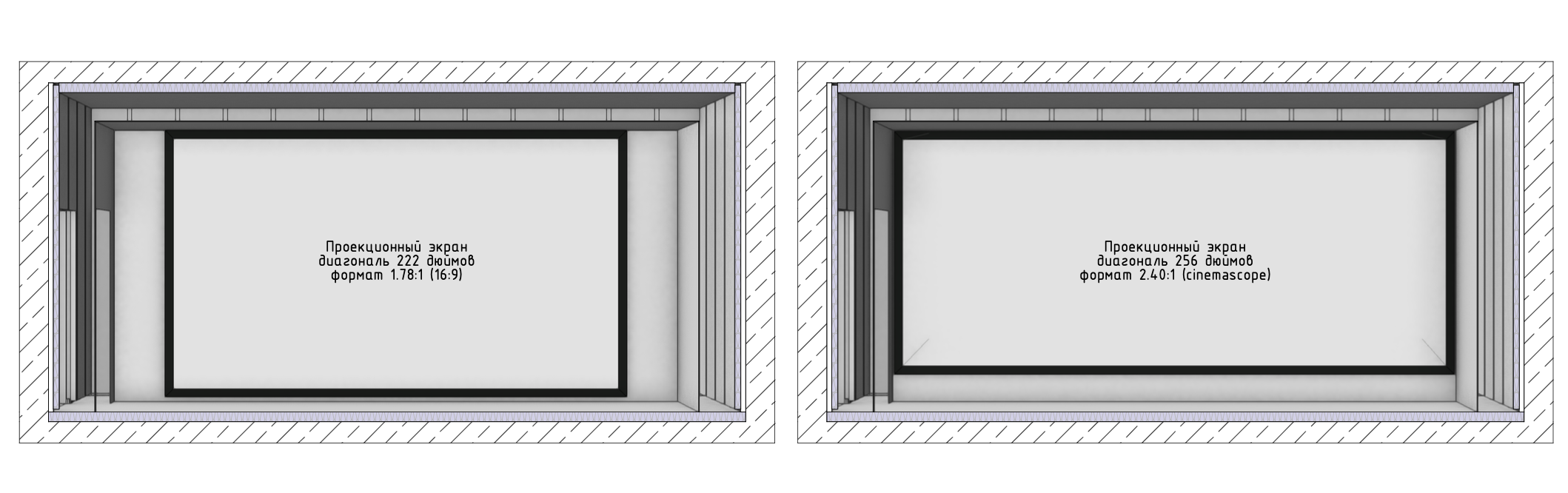
Electronic masking
When changing the format of the film on the screen may remain unused stripes. Cloaking system covers these areas with movable opaque panels or curtains, visually adjusting the boundaries of the screen to the image.
Masking can be motorized and controlled automatically along with the video system. It helps to maintain a neat image frame and reduce the visibility of unused areas of the screen. If necessary, we design systems for several formats.
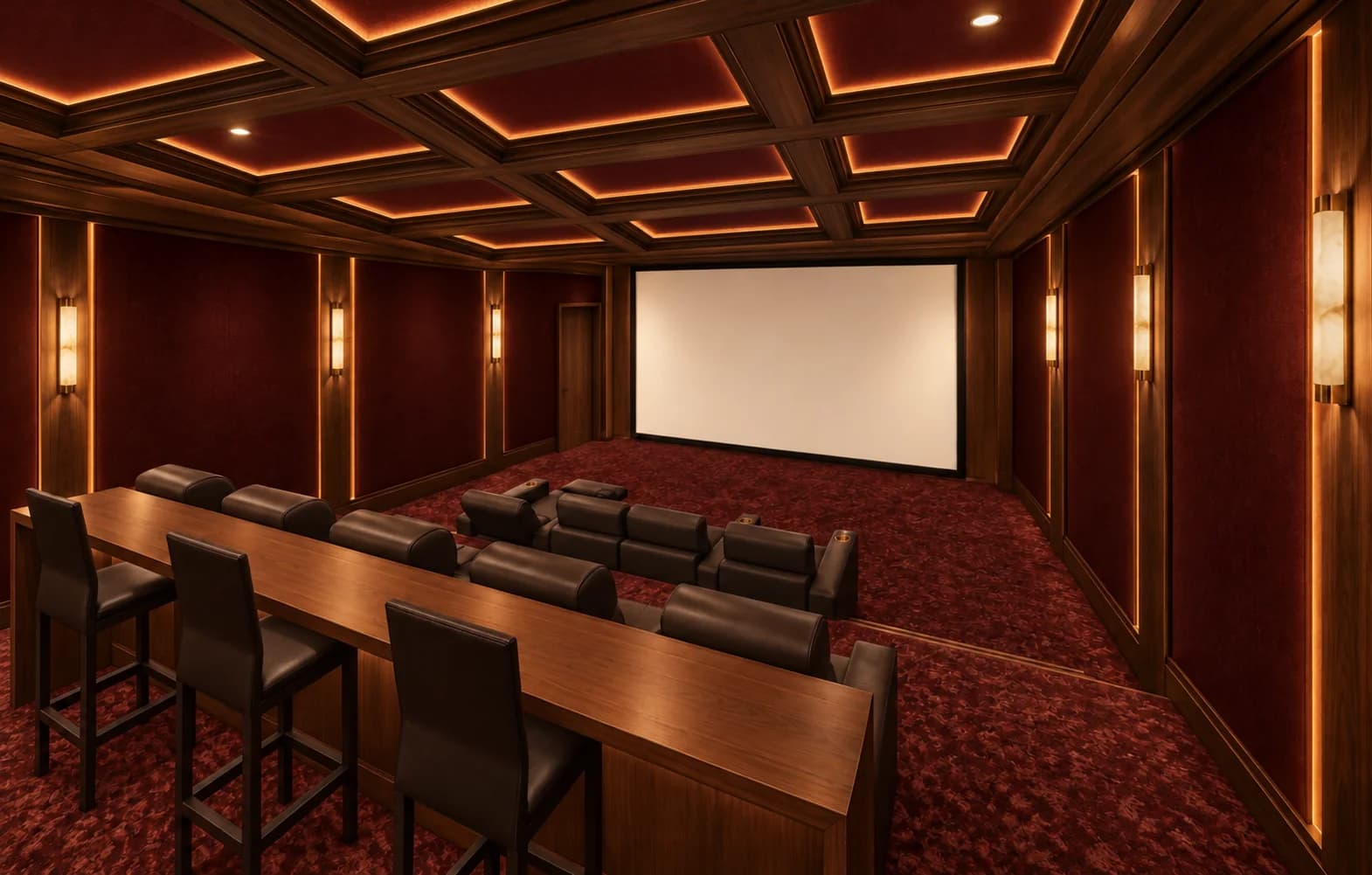
Viewing angle: how big the screen should be
The diagonal itself doesn't say much. The same screen from three and seven meters is perceived in completely different ways. Therefore, when designing, we calculate the horizontal viewing angle - how much of the field of view is occupied by an image from a particular viewer's place.
We love expressive, truly cinematic images and in many dedicated halls strive for a angle of view of more than 50° for the main viewing seats, if this corresponds to the viewing scenario and the comfort of the customer. This is our project-preferred objective, not a universal mandatory requirement of the standard.
Industry recommendations take into account the range of viewing angles, visual comfort, resolution and geometry of the hall. We check not only the center chair, but also other places: the view is important without obstacles, the position of the head and the ability to perceive the entire frame without constant stress.
The screen size is determined simultaneously with the distance to the audience, the brightness of the projector and the parameters of the lens. This is how the screen becomes part of an engineering project.
Light and interior: why darkness matters
The projection is particularly sensitive to outside light. Even a very good projector loses the depth of black when light hits the screen from windows, fixtures or reflection from walls and ceiling.
In a dedicated cinema, we design controlled dimming and carefully select materials around the screen. The colour of the finishes can be different : not only the dark palette is important, but also the low reflectivity of the surfaces. Matte fabric and properly selected acoustic materials help reduce parasitic reflections of light back on the screen.
Therefore, we are cautious about glossy walls, mirrors, polished stone and other strongly reflective surfaces in the viewing area. Their use requires a separate evaluation. Lighting at the same time can be spectacular and multi-scenario - during the film it just has to work on the image.
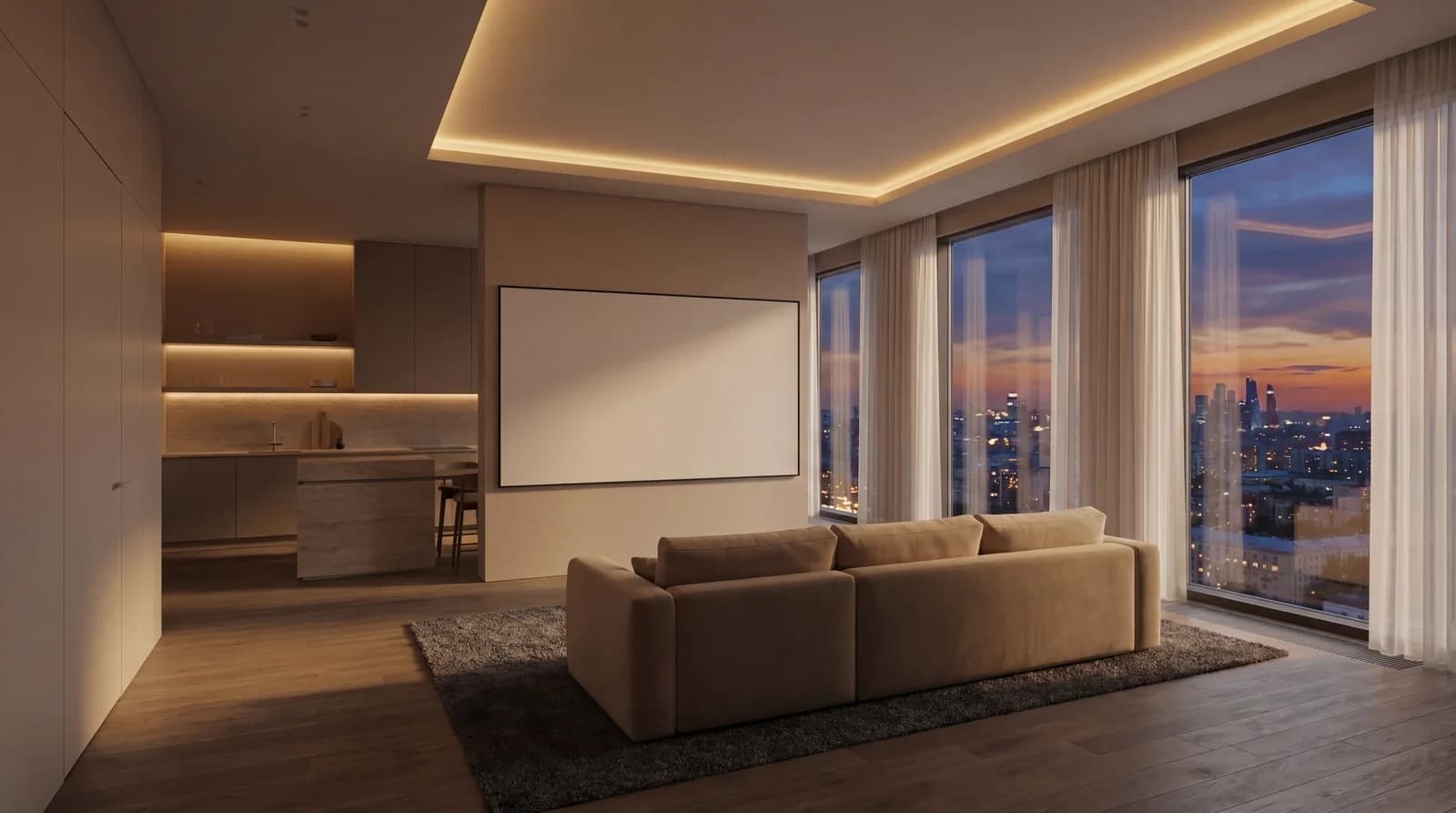
Media room: the screen appears on demand
Not every room needs a constantly open screen. In a living room or multifunctional media room, the video system can be almost invisible until it is used.
We design motorized roll screens, including completely hidden mounting solutions: the body is placed in the ceiling space, and the canvas is lowered only when you start viewing. The projector can also be on a motorized ceiling elevator and extend synchronously with the screen.
In such rooms, more compact projectors are allowed, as well as TVs - often the most practical solution for daytime viewing, games, news and TV shows. Modern OLED and LCD TVs provide high brightness and contrast without the need to darken the room to the level of a dedicated cinema. The choice depends on the size of the image, landing, lighting and architecture.
MicroLED: When the screen creates light
Along with the projection, MicroLED is developing – the technology of large screens assembled from LED modules. Unlike a projector, which requires a reflective canvas, this screen emits light itself: the image is formed by many tiny LEDs.
MicroLED is interesting for its high brightness, deep black colour, modularity and the ability to create very large images. Such systems are developed, in particular, Samsung and LG; there are also professional solutions for film screening.
One of the main advantages of MicroLED is its deep black colour. In black areas, the pixels are turned off and do not emit light. Therefore, the contrast of such screens is often described as practically infinite. In a real room, the perception of black also depends on external lighting and reflections on the screen surface.
One of the key characteristics is pixel pitch: the distance between the centers of neighboring pixels. The smaller it is, all other things being equal, the closer you can sit to the screen without noticing its structure. Therefore, we calculate the size, resolution and viewing distance together.
The modular design allows you to create not only flat, but also curved screens, if this supports a specific system and corresponds to the architectural task. At the same time, MicroLED requires special attention to heat generation, power supply, maintenance and placement of loudspeakers.
An important limitation of most home MicroLED screens is the lack of acoustic transparency: front-facing loudspeakers cannot simply be placed behind them as a projection canvas. Their location has to be decided separately. Commercial cinemas already use special acoustically transparent LED screens, such as Tricorne Premium LED, which allow you to set the acoustics behind the image. This is the property of a particular design, not all MicroLED systems.
Professional LED movie screens, including solutions presented in the industry by companies such as Barco, can be used to display DCI content with the necessary certified infrastructure and screening rights. Not every home MicroLED screen is suitable for this task.
Video processor and accuracy of reproduction
A modern film can contain very bright highlights and deep shadows that not every projector is able to show at the same time. Therefore, in complex video systems, we use specialized video processors, for example madVR Envy or Lumagen Radiance Pro, when their functions are really needed by the project.
One of the main tasks is dynamic tone mapping (DTM). It analyzes the brightness characteristics of the image and helps to adapt HDR content to the real capabilities of the projector and screen, saving more detail in light and dark areas. The specific algorithm depends on the device and settings.
The video processor can also perform scaling, aspect ratio management, signal processing, and other operations. Some of these features are already built into modern projectors and TVs, so an external processor is not always needed.
Design: from calculation to finished system
The video system does not exist separately from the architecture. We calculate projector position, projection distance, lens characteristics, beam geometry, screen size, viewing angle and required brightness on the canvas. Check whether the beam crosses furniture, spectators' heads or ceiling elements, and provide ventilation, food, cable tracks and access for maintenance.
Project solutions are coordinated in BIM-model Vectorworks. It helps to coordinate the screen, projector, ceiling structures, lighting, loudspeakers and building services before installation. Based on the results, we prepare working documentation for builders and installation team.
After installation, we check the image geometry, focus, brightness levels and settings of the video track, perform the necessary calibration. Our task is to ensure that the selected equipment shows exactly the result for which it was designed.
Cinema Project Approach
We don’t start with a question of which projector is more expensive or how many inches will fit on the wall. First, we determine the viewing scenario, spectator places, room capabilities and expected image characteristics. Then choose a screen, projector or self-luminous system, calculate their collaboration and coordinate everything with the architecture.
So there is a video system in which the large screen is really justified - in brightness, colour, geometry, usability and viewing experience.
Frequently asked questions
Which is better for a home cinema – a projector or a TV?
For a dedicated darkened cinema, the projector allows you to get a very large image and place the front acoustics behind an acoustically transparent screen. For a media room with daylight, TV is often more convenient. The solution depends on the size, lighting and tasks of the room.
How is a laser phosphorus projector different from an RGB laser?
In a laser-phosphor projector, some of the light is converted by a phosphor. In RGB laser, the primary colours are created by separate laser sources. RGB can provide a wider colour gamut, but the image quality depends on the entire projector design.
What are DLP and LCoS?
This is an image forming technology inside a projector. DLP uses micromirrors, LCoS - reflective liquid crystal matrices. Both technologies are found in high-quality projectors; you need to choose a specific model for viewing conditions.
What does 4K mean and how does it differ from E-shift?
Native 4K means that the projector matrix contains a physical grid of pixels of the corresponding resolution (with the cinema format 4096 × 2160 and home UHD 3840 × 2160 differ). E-shift is a technology that quickly shifts the image to fractions of a pixel, forming higher visible detail from the matrix with lower intrinsic resolution. This image may look very clear, but the physical resolution of the matrix is different.
What is 4K HDR?
4K describes the number of image details: for a home UHD, it is usually 3840 x 2160 pixels. HDR (High Dynamic Range) - Extended dynamic range, allowing more brightness and colour gradations to be transmitted in compatible content and hardware. The presence of HDR labeling does not mean that any projector will be able to reproduce the entire range without adaptation.
Why do you need a video processor?
The video processor processes the image before displaying it on the screen. Depending on the model, it can improve scaling, adapt HDR to display capabilities, manage frame format and perform other operations. We use, for example, madVR Envy and Lumagen when their capabilities are justified by the project objectives.
What is dynamic tone mapping?
Dynamic Tone Mapping is a dynamic adaptation of an HDR image to the real-world capabilities of a screen or projector. The system takes into account the characteristics of scenes or frames to preserve important details and avoid excessive loss of information in bright areas. Tone mapping is performed not only by external video processors: it is also found in the built-in processing of projectors and TVs.
Do you need 8K for a home cinema?
Today, most movies and TV shows are available in 4K or lower resolution. 8K upscaling improves output resolution through processing, but does not turn the source material into a true 8K in terms of the number of recorded parts. The utility of 8K depends on the diagonal, viewing distance, source quality and display device.
Why is the viewing angle important for the cinema?
It determines how much of the field of view the screen occupies. We often aim for a horizontal angle of more than 50° in the main places for the expressive effect of immersion, but we choose it individually taking into account the comfort, content and geometry of the room.
Which screen format should you choose: 16:9 or 2.39:1?
16:9 is convenient for TV series, games, YouTube and mixed content. The 2.39:1 wide screen is particularly suitable for a movie-oriented cinema in the appropriate format. In the presence of motorized masking, the boundaries of the screen can be adapted to different proportions of the image.
What is an acoustically transparent screen?
This is a screen canvas that allows you to place loudspeakers behind the image. It can be woven or micro-perforated. The material is selected taking into account its optical and acoustic properties, as well as the distance to the audience.
Is it possible to hide the projector and screen in the ceiling?
Yes. For media rooms, we provide hidden motorized screens and elevators for projectors. They can work according to a single management scenario and appear only for the duration of viewing. The possibility of installation depends on the design of the ceiling and the necessary mounting gaps.
How is MicroLED different from a projector?
MicroLED creates light directly on the surface of the screen, and the projector directs light to the reflective canvas. MicroLED can operate in higher ambient light, but requires solutions to power supply, cooling and acoustic location. For a dedicated cinema, both approaches have their advantages.
What is the MicroLED pixel pitch?
This is the distance between the centers of nearby luminous pixels, usually in millimeters. The smaller the step with the same design, the denser the image and the closer you can place the audience without a noticeable pixel structure.
Is it possible to watch premieres in a private cinema on the day of release?
This requires an appropriate professional screening infrastructure and separate rights to a particular film, including permissions and access keys when required. We design such systems; the possibility and date of display depend on the conditions of the copyright holder and distributor.